Showing posts with label Taxation. Show all posts

2013-03-05

Sequester Scare

Thomas Sowell wrote,
Back in my teaching days, many years ago, one of the things I liked to ask the class to consider was this: Imagine a government agency with only two tasks: (1) building statues of Benedict Arnold and (2) providing life-saving medications to children. If this agency’s budget were cut, what would it do?

The answer, of course, is that it would cut back on the medications for children. Why? Because that would be what was most likely to get the budget cuts restored. If they cut back on building statues of Benedict Arnold, people might ask why they were building statues of Benedict Arnold in the first place.

This is a nice illustration of what is known as the Washington Monument Gambit. That is, when making decisions about budget cuts, do the most harm with the most painful cuts possible so that you can reinstate the spending that you want.

The Whitehouse is unleashing WMG on the populous for political gain. And if that wasn't enough, as Sowell continues,
President Obama has said that he would veto legislation to let him choose what to cut. That should tell us everything we need to know about the utter cynicism of this glib man.

He doesn't want to make his own plan (sequestration) work, but wants to inflict pain on the poor and vulnerable in order to get his way. Possibly because that plan was never intended to work budgetarily, but was a political maneuver to check mate the GOP.

Harming the most needy is usually the sort of thing rich Republicans are accused of – whether they have the power to do such things or not – and here the President is actually doing it right before our eyes precisely because he has the power to inflict pain on the electorate.

2012-11-30

The GOP and the Fiscal Cliff

Here is a crazy and bold prediction: à la the 1994 government shutdown, no matter what happens with regard to the "fiscal cliff", the GOP will get the blame. Just as the right was fingered as the culprit for the housing bust even while they were sounding the alarm about the need for more regulation of Fannie Mae and Freddie Mac, so too they will be blamed for any detrimental effects of the fiscal cliff. Republican options for dealing with this issue include:

  • stay true to their values and pledges of smaller government and lower taxes;
  • put forth reasonable solutions such as the Ryan Plan;
  • agree to return to the full panoply of the Clinton era taxes;
  • put forward the Simpson/Bowles plan as a compromise;
  • just vote "present" and let the Dems march forward unresisted;
  • leave DC and hole up at the Best Western Clock Tower Resort in Rockford, Illinois;

But, it doesn't matter what the GOP does short of registering as Democrats and feeding grapes to Nancy Pelosi, they will be castigated by the Dominant Liberal Establishment Mass Media (DLEMM) and those on the left as obstructionist and intransigent.

And this will happen even though the left boldly proclaims their intransigence on a daily basis:

  • Before the election, Harry Reid said, "Mitt Romney's fantasy that Senate Democrats will work with him to pass his 'severely conservative' agenda is laughable."
  • Harkin and Rockefeller asked Obama to "reject changes to Medicare, Medicaid and Social Security that would cut benefits"
  • The Congressional Progressive Caucus said that entitlements are off the table
  • Durbin, the Senate Majority Whip, said in a speech that under no circumstance would there be any entitlement reform.  
  • Krugman says, "Mr. Obama should hang tough, declaring himself willing, if necessary, to hold his ground even at the cost of letting his opponents inflict damage on a still shaky economy. And this is definitely no time to negotiate a 'grand bargain' on the budget that snatches defeat from the jaws of victory. So stand your ground, Mr. President, and don't give in to threats. No deal is better than a bad deal."
  • A pundit opines, "The president can win, without doing anything. He does not have to give an inch. Not an inch!"
Are these the voices of bipartisanship and compromise?  

The left sets up a situation where "negotiation" means something like 'You can choose any color you like as long as it is blue," and then accuses the right of stonewalling if they desire any color other than the shade of blue that the Dems are promoting. They are all for compromise so long as it is the GOP that does the compromising.


However, If the GOP compromises here - and by compromise I mean choosing the preselected, preauthorized positions of the left that are not open to compromise - they will just be yielding more ground to the all-encompassing entitlement state and will be part of the problem.  They will fix nothing and only slightly mitigate the slowing economy, higher taxes on everyone and increased debt. But worst of all, if there is even a trace of GOP DNA on the deal - GOP good intentions notwithstanding - the DLEMM and the left will pin all negative outcomes on the right and the GOP will bear the political consequences of failed policies no matter who authored them (e.g., housing bubble).

Since most agree that we are approaching the cliff at a high rate of speed, the GOP should let the left own the 'solution'. Many on the right argue against this because of the inevitable destruction resulting from leftist policies. But since our Thelma and Louise moment is nigh, will nudging the wheel so that we enter the atmosphere at an angle somewhat less than 90 degrees change the outcome? Will insisting that the windows remain rolled up before we sail off the cliff make the car any more drivable once we reacquaint ourselves with terra firma?

How could the GOP let the Dems own the solution? First, the GOP should set forth details about what they would do if they had control of all three branches. Second, they should propose Obama's own budget and tax plan with a nice acronym like AIRBORN, or FORWARD and vote "present". Lastly, the GOP should then let the Dems propose anything they like and vote "present".

The first move would establish a benchmark.

The second would, as much as possible, remove the ability of the DLEMM and the left (but I repeat myself) to blame and demagogue the right's attempts to inject sanity. And there is little likelihood of passage since Obama's plans have gone down in flames before. 


The last move would allow the Dems to wholly own the solution by letting them propose solutions without resistance. By removing the resistance, the Democrats would be forced to realistically deal with their own proposals. It is very likely that without a great Satan to battle against, the Dems would self-moderate rather than relying on the GOP to provide the moderation for them (as well as a scapegoat) and come to rest on something like Simpson/Bowles. A self moderated outcome may share many aspects with the Republican benchmark and the GOP could enjoy an 'I told you so' moment. But even if the Dems don't moderate their extreme positions, by voting "present" on anything the Dems propose the right gets absolution - not from the DLEMM or the left, but from their base and their conscience.

GOP moderation and compromise only serves to prolong the inevitable. Just as Democrats often stand in opposition to and protest against economic reality, we may be at the point where Republicans are standing in defiance of Schumpeter's reality, and they should, if reluctantly, step aside and allow creative destruction to do its work.

2012-11-15

Big Government Means Bigger Business

Newsflash: The rich are already rich. Higher tax rates don't prevent them from being or becoming rich. The wealthy are less concerned with higher tax rates because they will avoid taxation by shuffling their wealth around and by collaborating with government to ensure their position. Higher tax rates will not prevent GE and the Hollywood effete from acquiring wealth – they have already ascended. Large corporations are natural allies of heavy handed fiscal policy because they are better positioned to influence government in their favor and better able to reposition themselves financially and globally in order to skirt or avoid taxation. Big business is the natural ally of big government.

Tax rates do, however, have a mitigative effect on those moving through the economic continuum. In free societies people are not restricted to the class into which they are born. Unlike most economic systems throughout the world, capitalism allows for infinite mobility through the economic spectrum. But onerous tax regimes – and worst yet, being told that the system is rigged against you – can have profound and devastating effects on those trying to climb the economic ladder.

One of the better aspects of the 'creative destruction' of capitalism is the possibility of unseating the power structure. If the influence and control by the government is relatively weak then there is less ability for a group that has the policing power of the state to influence, collude and control. At the very least, corporations can be toppled by the next guy with a better mouse trap. Simply put, if WalMart is functioning in ways that offend your sensibilities, you can spend your dollar elsewhere. If government is doing a poor job, good luck trying to change that.

When a controlling bureaucratic labyrinth exists, the rich and powerful will seek to impose their will with the force of law. The small guy doesn't have the same ability to influence the heavy hand of government as the wealthy. Sure the little guy gets one vote. But the wealthy get that same vote plus a lobbyist. This is the impetus that motivates those with the notion of smaller government. It is mystifying that so many vote for larger government to control the economic and social reigns while thinking it will lessen the influence peddling.

Ironically, those who seek to lessen the shipping of jobs overseas, the consolidation of power and wealth into the hands of a few and reign in corporate behavior with taxation, caps, restrictions and regulation often make the problem worse. One must be careful when ceding power to the government or imposing one's will via government mandate to not just intend to do good.

2012-07-10

Obama: Keep Taxes Low

The President spoke about extending the current tax rates yesterday.

So we should all agree to extend the tax cuts for the middle class. Let's agree to do what we agree on. Right? (Applause.) That’s what compromise is all about.
Wha? Isn't a compromise when two sides give up some demands to meet somewhere in the middle? If we do what we agree on, that is not compromise. So what is really going on here?
Let’s not hold the vast majority of Americans and our entire economy hostage while we debate the merits of another tax cut for the wealthy. We can have that debate. (Applause.) We can have that debate, but let's not hold up working on the thing that we already agree on.
Republicans aren't opposed to this. So what is he talking about? He could sign a bill that extends the current tax rates for everyone and then 'have the debate' about returning the tax rates for the upper 2% of the taxpayers to what they were under Clinton.

It isn't the Republicans that are going to let the rates expire and move upward. It is Obama. What he is really saying is that 'if you don't do it my way I will not sign it and I will be forced to hold the middle class hostage but it won't be my fault because you didn't do it my way. Do it my way - no hostages. Their way - hostages.'

I guess that's what compromise is all about. Is this just more imperialism? (Strassel, Krauthammer)

He went on:
Let’s not hold the vast majority of Americans and our entire economy hostage while we debate the merits of another tax cut for the wealthy. We can have that debate. (Applause.) We can have that debate, but let's not hold up working on the thing that we already agree on.
There is no need to Mr. President. Just extend them and then have the debate.

He repeats:
So my message to Congress is this: Pass a bill extending the tax cuts for the middle class; I will sign it tomorrow. Pass it next week; I’ll sign it next week. Pass it next -- well, you get the idea. (Laughter.)

As soon as that gets done, we can continue to have a debate about whether it’s a good idea to also extend the tax cuts for the wealthiest Americans.
Well, by golly, Sen. Hatch introduced just such an amendment:
Sen. Orrin Hatch (R-Utah) introduced an amendment Tuesday that would extend all the Bush-era tax cuts for another year.

Hatch wants to attach the amendment to the Small Business Jobs and Tax Relief Act (S. 2237).
So mission accomplished? Set the hostages free? Let the debate begin? Not likely.

Earlier he noted:
So the money we’re spending on these tax cuts for the wealthy is a major driver of our deficit, a major contributor to our deficit, costing us a trillion dollars over the next decade.
"The money we're spending"??? Letting people keep more of the money they earned is spending?  Doesn't this presume it is the government's money to begin with? Why, when the government takes less of somebody's earnings in taxation, is it called "spending" but when money is taken from some and spent on 'stimulus', food stamps, 90 weeks of unemployment, etc., it is "investment"? Shouldn't he have said that "the money we’re investing on these tax cuts for the wealthy is a major driver of our deficit"?

Aaaand, these rates are "a major driver of our deficit"? $5.170 trillion additional deficit over 3.5 years compared to the possibility* of $1 trillion in additional revenue over 10 years - or $350 billion over 3.5 yrs. Yup. Had it been in place for Obama's entire presidency, it would have reduced the deficit by about 7%. Major contributor all right.

Jay Carney tried to defend the statements:


* This assumes production, a static model, and that incentives don't matter.

2012-06-08

The Private Sector Is Doing Fine


The truth of the matter is that, as I said, we created 4.3 million jobs over the last 27 months, over 800,000 just this year alone.
From Taranto:
The night before the jobs report came out, Timothy Egan of the New York Times wrote that "the verdict is still out" on the president's economic record. "Because he got hit with the Bush hangover, his overall job numbers show a net loss of about 850,000, from January 2009 to the present," Egan writes. "But if you start a year into his presidency, Obama has added almost four million jobs."

The verdict is also still out on the 2012 Chicago Cubs. Sure, if you count the whole season, they have one of the worst records in the Major Leagues. But if you ignore their losses, they're an impressive 18-0.
Back to Obama:
The private sector is doing fine. Where we're seeing weaknesses in our economy have to do with state and local government. Oftentimes cuts initiated by, you know, Governors or mayors who are not getting the kind of help that they have in the past from the federal government and who don't have the same kind of flexibility as the federal government in dealing with fewer revenues coming in.
By funneling more money from the feds who have flexibility in dealing with lower revenues does he mean more stimulus? And by flexibility does he mean borrowing and printing? Those are two things state governments can't do.
And so, you know, if Republicans want to be helpful, if they really want to move forward and put people back to work, what they should be thinking about is how do we help state and local governments and how do we help the construction industry? Because the recipes that they're promoting are basically the kinds of policies that would add weakness to the -- to the economy, would result in further layoffs, would not provide relief in the housing market, and would result, I think most economists estimate, in lower growth and fewer jobs, not more.
Says he.

2012-05-08

Taxation Without Representation

Millions of illegal immigrants are getting a bigger tax refund than you. Eyewitness News shows a massive tax loophole that provides billions of dollars in tax credits to undocumented workers and, in many cases, people who have never stepped foot in the United States. And you are paying for it!


And there probably isn't any voter fraud either. Oh, wait...

2012-05-07

Julia - Cradle to Grave

Ross Douthat takes a look at the Obama campaign's Julia ad.
What’s more, she seems to have no meaningful relationships apart from her bond with the Obama White House: no friends or siblings or extended family, no husband (“Julia decides to have a child,” is all the slide show says), a son who disappears once school starts and parents who only matter because Obamacare grants her the privilege of staying on their health care plan until she’s 26.
Its all about her. Kinda self-centered, right?

He goes on:
In addition to ignoring the taxes that will be required of its businesswoman heroine across her working life, “The Life of Julia” hails a program (Head Start) that may not work at all, touts education spending that hasn’t done much for high school test scores or cut college costs, and never mentions that on the Obama administration’s own budget trajectory, neither Medicare nor Social Security will be able to make good on its promises once today’s 20-something Julias retire.
Would the ad be as effective if Julia's name were José or Shaniqua? Doesn't the Obama campaign care about minorities?

2012-05-01

Ryan Plan Draconian?


If I'm hearing Ed correctly, and I think I am, he likes the phrase "grease the skids." Yes Mr. Johnston, that's what the GOP wants. "Take it from the working people, and the poor and the disabled and the children so the rich can have more. And then everything will be great." I think he left out the elderly, women, blacks, Hispanics, babies and cute bunnies. Johnston really missed an opportunity to hit that one out of the park.

This is reminiscent of how the left generally treats the right. It is like when Howard Dean said: "Our moral values, in contradistinction to the Republicans', is we don't think kids ought to go to bed hungry at night." Yes. Republicans want children to go hungry.

Can we put on our big boy pants and discuss issues without demonizing everyone who isn't on the show? Mysteriously, no talk about how working people, the poor, the children, the disabled, the elderly, the babies and bunnies will pay down the debt racked up by this generation. Any concern about the disabled in that regard?

Go ahead, stick it to the "rich". Take everything they have. Unfortunately, you could take everything and it wouldn't come close to solving the problem. See why.

If the territorial tax is a dodge, then let's get rid of it. Although how is this much different than how Hollywood (just one example) conducts business by going where the taxes and wages are lower to make movies. The left does not practice what they preach. If they preached what they practice, they would be conservatives.

The piece of this puzzle that Schultz and Johnston cannot reshape is that businesses will gravitate to states/countries that are the most business friendly. You would do the same thing. Unmentioned is that higher energy and tax rates will push companies overseas too. Will Schultz hammer the left about their energy and tax policies driving jobs overseas? (No answer needed. It was a rhetorical question.)

But hey, at least Ryan and the Republicans have offered a plan. It is a little odd that Schultz and Johnston aren't as concerned that a budget hasn't been passed for 1097 days even though it is against the law not to. And every Obama budget has been a voting blow out. Dems won't even vote for it. 414-0 on the last go-round. Why do you suppose that is? The President is a pretty smart guy. He should be able to propose something that at least one Dem would like.

But the GOP will get blamed for not reaching across the aisle - partisan politics and all that. Even while Dems refuse to vote for the Obama plan and then don't pass something of their own. As for the Obama budget - heretofore the only response to the Ryan budget - Mark Steyn sums it up thusly:
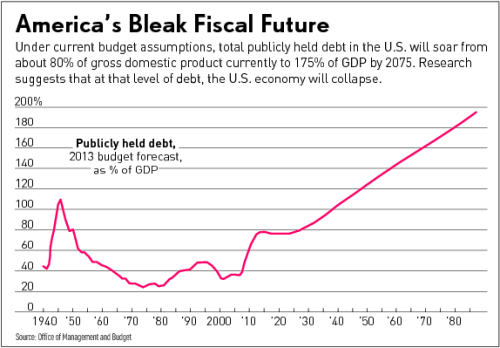
Have you seen the official White House version of what the New York Times headline writers call “A Responsible Budget”? My favorite bit is Chart 5-1 on page 58 of their 500-page appendix on “Analytical Perspectives.” This is entitled “Publicly Held Debt Under 2013 Budget Policy Projections.” It’s a straight line going straight up before disappearing off the top right-hand corner of the graph in the year 2084 and continuing northeast straight through your eye socket, out the back of your skull, and zooming up to rendezvous with Newt’s space colony on the moon circa 2100. Just to emphasize, this isn’t the doom-laden dystopian fancy of a right-wing apocalyptic loon like me; it’s the official Oval Office version of where America’s headed. In the New York Times–approved “responsible budget” there is no attempt even to pretend to bend the debt curve into something approaching reentry with reality.

As for us doom-mongers, at the House Budget Committee on Thursday, Chairman Paul Ryan produced another chart, this time from the Congressional Budget Office, with an even steeper straight line showing debt rising to 900 percent of GDP and rocketing off the graph circa 2075. America’s treasury secretary, Timmy Geithner the TurboTax Kid, thought the chart would have been even more hilarious if they’d run the numbers into the next millennium: “You could have taken it out to 3000 or to 4000” he chortled, to supportive titters from his aides. Has total societal collapse ever been such a non-stop laugh riot?

“Yeah, right.” replied Ryan. “We cut it off at the end of the century because the economy, according to the CBO, shuts down in 2027 on this path.”
The graph, in case you're interested:


The Ryan budget is demonized because it focuses on reductions in spending. Any sensible person knows that spending must be controlled in their own budget at home. However, even the supposedly horrific poor/children/disabled/bunny crushing Ryan plan doesn't "cut" spending - it increases it. From the Fiscal Times:
Neither President Obama nor Paul Ryan actually cuts government spending. Rather, both are playing the time-honored game of calling a reduction in the rate of increase a “cut.” Thus, the president would increase federal spending from $3.8 trillion in 2013 to $5.82 trillion in 2022. That might not be as big an increase there might otherwise be, but in no way can it be called a cut. Meanwhile, Ryan, who is being accused of “thinly veiled Social Darwinism,” would actually increase spending from $3.53 trillion in 2013 to $4.88 trillion in 2022.

The president warns that Ryan’s spending “cuts” would “gut” the social safety net. And, it is true that Ryan’s budget knife falls more heavily on domestic discretionary spending than does the president’s – but only relatively. Over the next 10 years, Ryan would spend $352 billion less on those programs than would Obama, an average of just $35.2 billion per year in additional cuts. Given that domestic discretionary spending under the president’s budget will total more than $4 trillion over the next decade, Ryan’s cuts look less than draconian.
$35.2 billion per year. That's only about 2.6% of the current annual deficit. Ryan's budget would have to cut another 38 times as much to even stop the deficit spending. It would be as if you were told that on your $50k income this year, you would only go in debt $24,500 instead of $25,000. Ryan deserves all that opprobrium for proposing a draconian horror show of that magnitude, don't you think?

Both the Democratic option and the Republican options are on the spend more side of the equation. Ryan just spends 'less' more than Obama. But the GOP is painted as raping, pillaging and burning.

No cutting. Not extreme. Not Robin Hood in reverse. (Although a good case could be made that Dems are actually Robin Hood in reverse since Robin Hood took what was taken by the tax collector and gave the people their own money back. Remember Friar Tuck's exclamation: "Praise the Lord and pass the tax rebate!") God only knows what Republicans would be called if they actually proposed austerity measures and cuts in spending (instead of slower increases).

This all boils down to the different visions of the left and the right. One is unconstrained, redistributive and egalitarian and the other is constrained and libertarian. Neither is perfect. Each has its downside. It is unlikely that proselytizing will change one or the other's mind so the best we can do is strive for clarity. Clarity before agreement.

But maybe a consumption tax could fix this. End all prebates, rebates, exceptions, loopholes and deductions. Just pay a tax on everything that isn't food or utilities. Then those who earn and spend more will pay more. Although they currently pay the majority of tax anyway, so it is hard to imagine they could pay any more of the "fair share".

2012-04-18

Is the Tax System Fair?

In 2009 the top 1% of earners (those earning more than $343,927) paid 36.7% of all federal income taxes. The top 10% of earners (those earning more than $112,124) paid 70.5% of all federal income taxes. That leaves only 29.5% of the tax burden for 90% of the tax payers to pay.1 Is that unfair?

If this was a ten member bowling club that had to pay a $1,000 lane rental fee, it would be as if one guy paid $700, the next four guys in line paid $275 and the other five split the $25. This might be desirable based on their income or ability to pay – that is, from each according to his ability, to each according to his need – or some other concept of spreading the wealth around, but is it fair?

Let’s look at it a different way. Let’s say you and a coworker are paid the same. But what if your boss decided that he was going to take $300 out of your paycheck and give it to your coworker because he had children and therefore had greater needs. Would you be satisfied with your boss telling you that you just need to pay your fair share? And that if you don’t, you are selfish or mean spirited? Giving this charity may be a moral thing to do, but should it be coerced? By a government?

It might be a nice thing to do. It might be charity. It might be giving to one person based on his need while taking from another based on what he has. But it is hard to argue that it is fair.

The different visions of the role of government are at the root of this contention over the “pay your fair share” stuff. The left hates inequity in results more than it loves liberty. It views the role of government as the gatekeeper that should make sure outcomes are the same. And when the left uses the word fair, they often mean equalized.

Obama has said many times that he is not interested in whether things like the Buffet Rule actually increase revenues or help to reduce deficits. As he told Joe the Plumber, he – and by extension government since Obama was running for the top government position in the nation – needs to “spread the wealth around.”

Where this becomes demagogic is when Obama says things like the Buffet the rule "could raise enough money" so that we "stabilize our debt and deficits for the next decade." As has been demonstrated, and as is confirmed by Obama’s Treasury Department’s own numbers, it does little to nothing to stabilize anything. Obama is trying to have it both ways. He wants to make it seem like this is some sort of fiscally responsible thing to do when he knows that it won’t do anything to stabilize deficits. It seems more likely that it is intended to be part of the fundamental change to the American fabric that was promised during the ’08 election.

This was confirmed by White House aide Jason Furman when he clarified the President’s comments by saying that that the tax was never intended "to bring the deficit down and the debt under control." It is “a basic issue of tax fairness.” Well, if having the upper 10% of income earners pay almost 3/4 of the taxes collected isn’t “fair”, what is? Could this be a euphemism for egalitarianism? For political, economic and social equality?

This notion of “fairness” proffered by the left makes no sense in any other venue. But if we understand it to be what Obama himself has said he desires, a fundamental change, then it makes sense. Americanism, in large part, places liberty higher on the list of values than other things such as equality of outcomes. Those that established America valued liberty above other things and they said as much in the Declaration of Independence by identifying life, liberty and the pursuit of happiness. They also identified individualism and small government as important values.

Unless one thinks that the authors of the American founding documents were a bunch of uninformed, ignorant dunderheads, surely they understood the tradeoffs inherent in valuing individualism, small government and liberty above other things with respect to the role of government. And we know they did by their writings. They leaned heavily on a religious people who were elevated by decent moral codes to handle the areas of life not handled by a lean government.

Much of the fundamental change being discussed and implemented today, however, seems to seek to have the government take on the role of churches and charity. Why this isn’t seen as the ultimate breaking down of the wall of separation between church and state might be a mystery until one understands the different visions that motivate the left and right.

The left appears to see its role as that of church and state: the work of the Good Samaritan is the work of the state; charity is to be fulfilled by the state; ensuring that nobody does too well or too badly is the work of the state. It is not that these endeavors are to be shunned or left undone, but one must ask whether charity should be the role of a secular government?

As a recent example of this inclination, Justice Ginsburg, a SCOTUS Justice of the left, told an Egyptian interviewer that she likes South African Constitution (SAC) better than the US Constitution (USC). The SAC claims numerous “positive rights” such as housing, healthcare, food, water, and Social Security. In contrast, the USC has a concept of rights which takes the form that government and individuals will not prevent anyone from taking various actions. That is, the USC defines rights as things that are not an imposition upon others and do not limit the rights of others whereas the SAC defines rights that necessarily must be monitored and provided by the government, that infringe upon the rights of others and require taxation for the provision of certain goods and services. It is a clear example of the differing visions of the left and right; of collectivism and individualism; of dependence and liberty.

So just because the right sees limits to the role of government does not therefore mean that they are craven, hateful and mean-spirited. They just have a different vision about what the role of government is. That it should be limited. That it should honor individuals. That it should champion liberty. They share this vision with many of those who established America in the first place. And that is pretty good company to keep.


1 http://www.ntu.org/tax-basics/who-pays-income-taxes.html

2011-12-23

Bush Tax Cuts

The current tax rates are what they are. Why is changing the current rates referred to as removing the Bush tax cuts rather than calling them the Obama tax rate increases?

2011-12-01

Down With Capitalism

Chris Carrado has a great article that examines some of the motivations behind the Occupy Wall Street movement:  the left hates inequity in results more than it loves liberty, they hate profit more than they love freedom in markets.

If a company earns millions in profit because it develops a revolutionary medical device that saves thousands of lives, has it not paid its fair share? If a company produces a chemical that kills 99.5% of bacteria in farms, has it paid its fair share? If Ford creates a car so safe that it prevents 80% of otherwise fatal auto accidents, has Ford not done enough? If a grocery chain brings us a bounty of diverse, healthy foods we can purchase without the cost and effort of growing them ourselves, do we think we're also entitled to the profits it brings that chain?

2011-08-31

Affirmative Action for the Ugly

Once again, The Onion is eclipsed by the New York Times. Daniel S. Hamermesh questions whether certain EEO actions might be reasonable based on ugliness.
...why not offer legal protections to the ugly, as we do with racial, ethnic and religious minorities, women and handicapped individuals?

We could even have affirmative-action programs for the ugly.

For purposes of administering a law, we surely could agree on who is truly ugly, perhaps the worst-looking 1 or 2 percent of the population.
This is a powerful example of the conflict of visions that exists between conservatives and liberals. One side seeks to impose equivalence via government coercion and lawsuits and the other does not. One side says the government should be the arbiter of morality while the other does not. One thinks in terms of groups while the other does not.

An important issue was noted near the end of the article. Often, the left does not acknowledge that incentives matter. In the case of taxation, they often dismiss the chilling effect that higher tax rates can have on investment and economic growth. They often poo-poo the idea that the wealthy may decide to change their behaviors if tax rates are to high. But in his article about ugly people, Hamermesh notes that incentives certainly do matter:
There are other possible objections. “Ugliness” is not a personal trait that many people choose to embrace; those whom we classify as protected might not be willing to admit that they are ugly. But with the chance of obtaining extra pay and promotions amounting to $230,000 in lost lifetime earnings, there’s a large enough incentive to do so.
Hamermesh feels that the ugly among us will embrace their ugliness if lured out with the prospect of financial remuneration. If true, those on the left should certainly concede that confiscatory tax rates, 90 weeks of guaranteed income in form of unemployment insurance and paying no taxes at all (as about 50% of Americans do) may in some way affect the decisions that people make.

For those who still possess some modicum of shame, they would likely not be able to expose themselves to the crushing humiliation of asking for a handout because of their uncomeliness. Their self-esteem is likely fragile as it is and having to be judged by some pulchritude panel may be more than they can bear. But those without shame would be lining up with their hands fully extended to exploit this program of good intent. I suppose those with face tattoos, meth mouth and other self-imposed disfigurements could benefit from this as well.

But Hamermesh places a low percentage on who would be eligible - one or two percent. So the competition would be steep for those racing to the bottom of the beauty pool. And given the track record of other public programs, we can all sleep well knowing this number would likely not grow and costs would be contained. For those of you enamored with large government programs, that was a joke.

As many ideas and programs of this nature, it stages - whether intentionally or not - a race to the bottom. It does not elevate people. It creates a culture where we are told to gather based on our shared grievances.

2011-08-24

Neuralgicism

NPR's Robert Siegel asked this of former NAACP Chairman Julian Bond (link):
Some people read into the Tea Party's almost neuralgic reaction to government spending, a sense that white people figure black people benefit disproportionately from federal programs. Do you suspect a racial subtext to that whole argument?
Of course, Mr. Bond felt that there is a racial subtext as well as envy animating the Tea Party.

Is it possible that the Tea Party just has different ideas about deficit spending?

Could it be that the race of the recipients doesn't matter; the Tea Partiers just want smaller government and lower spending?

Is it possible that the Tea Party supporters don't see somebody else is getting a government benefit and therefore feel envious and want some too, but rather, don't want it for themselves and think the current levels of spending are fiscally irresponsible?

Is it possible that a black person could agree with the Tea Party and think some reductions in spending are in order?

Might it be that the desire for smaller and limited government is a thought unto itself and entirely unrelated to race?

Doesn't this argue that if there were no blacks in the United States that the Tea Party would feel it is OK to borrow and spend trillions? That it is only because of the racial subtext that Tea Partiers think excessive spending is wrong?

Bad Billionaire

If a man has enough personal wealth that he is giving away $1.7 billion per year, why is he not considered a greedy corporate bastard? Why is he not greedy for profit at any cost, with no consideration for the consequences of his actions? Why has he not disowned his people and country in favor of globalization? Why is he not considered obscene and psychopathic? Why is his work not manipulation of markets? Why is he not thought to evade his tax responsibility while putting the burdens of his theft on humanity - especially since he repeatedly tells the world he does not pay enough in taxes?

These are all things said about other corporations and CEOs.

2011-08-17

Food Stamps are a Stimulus

The Obama administration sees food stamps as an economy booster.


According to the demand side hypothesis, infusions of money from the tax coffers stimulates the economy by creating demand for goods and services where it did not previously exist. In fact, the effect of these infusions is said to create a multiplier effect – each dollar spent has better than a one dollar effect on the economy. ($1.84 according to Obama’s Secretary of Agriculture Tom Vilsack.)

The argument for a demand side economy goes something like this:

Capitalism is driven by demand not by supply; supply just responds to demand. If that demand is not there, investors will be reluctant to fund a project, no matter how innovative it may be, choosing instead to put their money in investments that offer lower return but are safer and more secure. Supply side largesse for the rich might not go into capital formation, but might simply make the rich richer. While investment capital is extremely important in getting an innovative process started, it is consumer demand, not supply, that drives the process and keeps it going.

This Seattle Post Intelligencer article highlights a typical (in that they stimulate the supply side of anything 'green') infusion of money by demand siders.

  • The question that immediately comes to mind is, why are those that insist that government spending should enter the economy on the demand side (such as food stamps) spending $20 million (or any amount) on the supply side? Doesn't this violate the very nature of demand side philosophy?
  • If, as noted in the demand side description above, there is little or no demand (3 homes weatherized seems like low demand), won't the money just wind up in lower return, secure hideaways?
  • Why is this stimulus spending not simply making the rich richer in accordance with demand side philosophy?
  • From a Keynesian perspective, wouldn't this money have been better spent by giving out vouchers earmarked for weatherization upgrades to homeowners and let the supply side respond in accordance with the demand side philosophy?

2011-08-05

Foreign Look at Debt Crisis

Der Spiegel article on the debt crisis.

The left-leaning Die Tageszeitung writes:
What is happening in Washington is nothing less than a culture war. On President Obama's side are supporters of a national concept, like one known in Europe, namely that the state should take care of a certain amount of social equalizing, and if necessary, intervene with regulations. For his opposition, even Obama's idea of expanding health insurance coverage equals the birth of communist totalitarianism.

Anyone who raises taxes or increases the debt ceiling, and therefore unleashes the Leviathan of 'big government,' is, according to their logic, threatening the highest ideal that the American revolutionaries fought for: freedom. Those who do it will be pursued by these self-named patriots with virtually pathological hatred, even when the infrastructure or social benefits would profit from their undertakings. Illogical? Patriotism is possibly the only thing that many uncertain American citizens have left. The crisis has not only cost them their jobs; it has also threatened their country's hegemony. And a solution for none of these problems seems apparent.
The business daily Handelsblatt writes:
Obama .... will have a much harder time than in prior elections because he'd convinced his supporters that he would end the divide in America. But he's failed to prove that he can really achieve that. 'No, he can't' should be the conclusion of disappointed voters.
The Financial Times Deutschland writes:
The debt burden per person is, in the end, almost as high as in Greece.

2011-08-03

Compromise

There is a lot of discussion about how the Tea Party Republicans are intransigent and are unwilling to compromise during the debt ceiling debate. Nanci Pelosi said that Democrats "were forced into something in order to raise the debt ceiling." Apparently they were reluctant to compromise too.

Of course people want as little compromise as possible. They have ideals, beliefs values and visions that differ. And to the extent that they compromise their beliefs they are sacrificing their values. (This isn't to say we shouldn't compromise. Just that compromise comes at a price.)

This is true for Democrats and Republicans. Democrats want to give up as little ground as possible just as Republicans do. Democrats are as unwilling to negotiate away their beliefs as Republicans. Would Rep. Pelosi feel uncomfortable negotiating away key elements that she thought were vital and important? We know the answer because of her past record and acknowledging that there are "bitter pills" in the bill. But is she asking the other side to set aside their beliefs without putting up resistance?

Also, agreeing that it is a "Satan sandwich" indicates her lack of desire to vote for this bill and her desire to not have to compromise her beliefs.
It probably is, with some Satan fries on the side.
That's called compromise.

2011-07-24

Political Manuever

The fact that we are here today to debate raising America ’s debt limit is a sign of leadership failure. It is a sign that the US Government can not pay its own bills. It is a sign that we now depend on ongoing financial assistance from foreign countries to finance our Government’s reckless fiscal policies. Increasing America ’s debt weakens us domestically and internationally. Leadership means that ‘the buck stops here.' Instead, Washington is shifting the burden of bad choices today onto the backs of our children and grandchildren. America has a debt problem and a failure of leadership. Americans deserve better.
Sen. Obama, Congressional Record, S.2237-8, 3/16/06
Both President Obama and Harry Reid now state that their past positions on the debt ceiling were merely political stunts.

Senator Obama

Harry Reid


The President said:
I think that it's important to understand the vantage point of a Senator versus the vantage point of a...President. As President, you start realizing, "You know what? We-- we can't play around with this stuff. This is the full faith in credit of the United States." And so that was just a example of a new Senator, you know, making what is a political vote as opposed to doing what was important for the country.

Was it OK to "play around" with the full faith in credit as a Senator? Does he now think an apology to the former President and the American people is in order?

2011-07-22

Right Wing Myths

The following article was forwarded by a friend. The article is reproduced in its entirety with my comments embedded.

Deconstructing Right-Wing Myths About Socialism, Capitalism, and Who The ‘Job Creators’ Are

Conservatives have taken to a new spin on truth, by refashioning definitions of words and terms in order to provoke new connotations. Socialism is now defined as a government take over, Capitalism is now defined as patriotic, and the wealthy are now defined as job creators. But simply redefining these words will not change their true meaning, it is only myth making.

If the author is suggesting that these ideas are new, he is right if by new he means since 1776 when Adam Smith wrote Wealth of Nations. Or the years preceeding this milestone, since surely the ideas were floating around prior to Smith writing them down. And the author's rebuttal of the ideas is not new since the most thorough and enduring critique of the results of capitalism was given by Karl Marx in the late 19th century.

Just because the author disagrees with some aspects of Capitalism does not render the ideas mythical. Just as there is value in some aspects of socialist commentary, so there is value in certain capitalistic aspects. Polarizing the issue will create more mythical dogma than an honest discussion of controlled vs. free economies.

Surely the author is aware that the US economy is a mixed economy. The markets are not "free" in the sense that they are unregulated. A quick examination of the Federal Register will disabuse the reader of any notions that the economy is not at least well regulated and possibly highly or over regulated.

Socialism does not mean the abolition of a free market society, nor does Socialism call for a government takeover of all industry; that is Communism.

It is refreshing to see a reasonable definition of Socialism presented. The classic dictionary definition does identify the "collective or governmental ownership and administration of the means of production and distribution of goods." Those on the left in America tend to use this as evidence that the policies pursued by those on the left are therefore not Socialist. However, the term has somewhat evolved over time and the author makes an important distinction between Communism and Socialism. A better definition may substitute "the most important industries are owned or controlled by the whole community" for ownership of means of production. Certainly Europeans understand this concept since they have parties with the word Socialist in the title and yet they are not advocating the total takeover by government of the means of production. It is possible to regulate or administer industry to the point that Socialism is achieved without actual ownership by the government.

It is difficult to have meaningful conversations about anything if the definitions of terms cannot be agreed upon. To be sure, the right wants less government control moving toward the ideal of capitalism and freer markets while the left wants more government control moving toward the ideal of socialism and egalitarianism. As the author so adroitly points out later in the article (a point that I incessantly make with the hope of fostering meaningful interactions by de-fanging both sides of the issue), "Capitalism is neither right nor wrong, it is simply an economic term." Similarly, socialism is neither right nor wrong, it is simply an economic term. If economic concepts and models cannot be summarized into generalized terms, what hope is there of discussing anything? Growth in thought and understanding cannot be achieved if we must restate a thesis in its entirety and are not allowed to use terms that generally encapsulate an idea or body of ideas.

Therefore I applaud the author’s candor and willingness to view the terms as descriptors rather than pejoratives.

Socialists acknowledge the limitation of a free market and believes that some industries should not be run for profit. Police protection, fire protection, prisons, education, health care, parks, electricity, water supplies, waste and sewage removal, and roadways are just a few examples of industries which should not be run for profit. The reasoning behind this belief is when these industries are operating for profit, not only will prices rise, but corresponding services would then be reserved only for those who can afford them.

This assertion does not account for competition, price setting and other market forces. Certainly, if a producer of goods is solely motivated by profit and is a price setter, this could lead to ever escalating and out of control prices. However, these are two assumptions that are not borne out by experience.

An understanding of price setters and takers is necessary. A company that is able to dictate the price its customers pay for goods and services is a price setter or price maker. All other companies that are competing in a similar market where similar products are readily available elsewhere are price takers. For example, a company that is selling computers cannot set the price arbitrarily high if others are competing for a market share. If it does, it will not sell units because the consumer can go to the competitor and receive a similar product for less. Therefore, the first seller is forced to lower prices to a market clearing price. That is, a mutually agreeable price is reached between buyers and sellers. This price is determined by the cost of manufacture, the perceived value of the product, profit, etc.

Any company that is producing something will necessarily maximize profits for the shareholders. However, this is limited by how much a buyer is willing to pay. If a TV manufacturer decides to include a 100% profit in the price of its TV, the buyer may decide that the added value of having a TV in the home is not worth the price. This desire to price set is mitigated by the market when another company sells the product cheaper – maybe deciding to produce the product with less profit. The second company can undercut the competition and gain a larger portion of the market share. This will have the effect of driving down prices at the first company if they want to stay in business.

Price setting generally occurs with monopolies, companies that are producing something that is so unique that there is no competitor making a similar product, collusion, etc. For these reasons and others, governments are likely to be price setters. (e.g., government monopolies are often established by law for various reasons.) The only relief for the consumer is for him to not purchase the product or service. However, since governments tend to control necessity items and/or items that are mandated by law, the consumer is not as free to make value/price considerations.

The author’s assertion that operating for profit only results in higher prices disregards market forces and empirical evidence to the contrary. It could be just as easily asserted that the monopolistic, regulatory and price control characteristics of government lead to higher prices.

Or more succinctly, no one person should be able to profit over running services, in which everyone benefits from.

The assertion here focuses on "no one person." Corporations do employ CEOs and the like, but shareholders make up a much larger portion of those benefiting from the profits of an organization. The elderly woman who holds stock in her retirement account for a corporation is certainly hoping for profitability to sustain her retirement.

And where does this line of reasoning stop? How is “in which everyone benefits from” defined? What portion of society must benefit to qualify? Certainly the author would therefore condone the socializing of the production and distribution food, heating and air conditioning, automobile, energy (including oil, gas, coal), and many other goods and services. All one has to do to turn control over to government is make the case that “everyone” benefits.

One excellent example of Socialism in action is demonstrated in our banking industry. While most banks operate for the profits of their CEOs,

If the author believes that the sole reason to exist is to operate for the profit of the CEO, there is no refutation possible for this belief. Certainly some take advantage of systems and try to get as much money as possible from the system, this does not therefore justify the tarring of an entire industry. Just as some lawyers appear to be heartless, soulless people that would sue their own grandmothers, this does not therefore mean that all lawyers are evildoers. Most people try to maximize their take for their efforts. Labor unions do exactly this when they lobby to mandate certain rules in the workplace. This does not necessarily obviate their efforts or necessarily make them evildoers.

credit unions are owned and operated by the people. The profits which are not imparted upon CEOs are reflected back to the customer in higher interest rates for investments and lower interest rates for loans. It may be important to point out that credit unions did not run the same risks as banks when our financial bubble burst, and thus did not need to request nor receive any TARP bailout money. Nor have the credit unions contributed to the faulty foreclosures as our banks have.

The credibility of the author is at risk if he is making the case that profits were the primary reason for the "financial bubble." I am no fan of extremely high compensation for executives, especially if it comes by deliberately and intentionally manipulating accounting to hit earnings targets so that senior management can maximize the bonuses and other executive compensation they receive, at the expense of shareholders. But this is exactly the source of the $90M received by Franklin Raines while he was in charge of Fannie Mae. And his support and implementation of policies to ease credit requirements on loans that Fannie Mae purchased from banks that were "a notch below what our current underwriting has required" may have contributed at least as much to the foreclosure problem as his extravagant $90M bilking of borrowers and the $400M civil fine paid by Fannie Mae.

Furthermore, the author has unwittingly made a good case for not socializing banking. He appears to be arguing that by removing bureaucratic control and decentralizing the decision making by placing it in the control of those who are most interested in conservative and judicious use of the assets - the consumer - that tragedy can be averted.

Another example is found in health care. The free market creates for-profit businesses ranging from medications, medical testing, medical treatments, medical research, to hospitals. None of which have lowered the cost of health care through innovation or through competition.

Absent a parallel universe, how can this statement be made with certitude? The medical cost issue is complicated, messy and needs an intervention. However, to assert that competition and innovation are not fostered by free markets strains credulity. Does competition and innovation bring about the lowering of cost in any other arena? Are groceries cheaper, better and more available because of competition? Does this inability of the market to reduce prices only exist in healthcare? And if so, why? It may not exclusively be the free market aspects that are messing up the healthcare industry. Could regulation and rule making play any role? It is likely not all one thing or the other. This is an incredible statement for the author to make.

This is because the demand of which is a basic necessity, or in other words is non-negotiable. Like clean water, oil, and electricity, humans cannot survive without such products or services. The demand of which is a constant, therefore they are not subjected to the Keynes supply and demand curve. When prices go up, demand does not lessen beyond a certain threshold. Americans may forgo a pleasure trip to conserve on gasoline consumption, but their demand for gasoline to take them to and from work is non-negotiable. Where the free market brings economic ups and downs which effects everyone, Socialism believes that there is a limit on the protections a free market provides. And quite simply, some things should not be run for profit, especially at the expense of everyone else.

The author’s primary objection appears to be profit. Profit in and of itself is not evil. I am sure the author allows that some profit is good. Labor unions want profit for the workers. They certainly want profit for the union itself, at the expense of everyone else. That profit is useful since much of that profit is used to influence elections in the form of political contributions and donations that help to elect politicians that create laws that ensure higher profits for the union members and therefore for the union.

This fixation on profit alone is fallacious. Is the author contending that the elimination of profit equates to the elimination of wrongdoing, waste, fraud, incompetence, and a whole host of other human frailties? The Franklin Raines debacle recited earlier should demonstrate that the ability of a company to make a profit is not the sole source of the author’s discomfort since Mr. Raines conducted his dealings in a quasi-governmental organization, under the watchful eye and collusion of OFHEO officials, and is a fellow of the left. If anybody should have been able to avoid this sort of exorbitant behavior, it should have been Mr. Raines and especially the co-conspirators at OFHEO. Failed human character might be a better place to point one’s finger.

If bad character is universal, it will crop up in corporations and government with similar frequencies. If not, are we to believe that something draws the seedy crowd to the private sector with greater frequency? Is it profit? But many would argue that power is more alluring even than filthy lucre. Is power as intoxicating to the politician as profit is to the businessman? And as corrupting?

Would the author argue that only the righteous enter politics while the immoral enter the private business world? Does this explain why, as the author proffers, if profit were removed and the government produced and distributed “some things” that prices would lower and quality rise? How is this squared with all the waste and fraud that leaders say they will excise from Medicare and Medicaid programs in order to lower costs and fund increases in benefits? Since profit couldn’t have produced the waste and fraud, from whence did it burst forth? It is a silly notion to think that corruption, greed, avarice, vice, et al. can be expunged from humankind by simply removing profit.

The Founders sought to minimize corruption and other vice by encouraging healthy religion to attack the moral problems of humanity. This is made clear from statements such as this one by John Adams:

“We have no government armed with power capable of contending with human passions unbridled by morality and religion.”

If the left wants to argue that religion is an antiquated method of moral conditioning that is no longer needed, that is fine. But moral conditioning will need to continue somewhere and somehow. The author is engaging in it when he makes moral judgments about profit. The reality is that if religion is not heavily relied upon as a co-worker in forming a good, just and moral government, then the government itself will have to take on the role of moral conditioner by imposing moral codes in the form of laws. If religion ceases as the primary agent of moral conditioning then government must take up the task. The moralizing of the left about not using government to legislate morality is hard to understand when the only avenue allowed by leftward policy is to have the government fulfill that role and, in fact, legislate morality. (This brings up interesting church and state discussions.)

Merely removing profit from the economic equation will not prevent bad bahavior.

Furthermore, when the author states that “some things should not be run for profit,” who shall decide which things are profit worthy and which aren’t? And if it is immoral to allow profit for this select group of chosen tasks, why would it be moral to allow any industry to function with profit?

Capitalism is an economic term for the free market system which is structured upon the accumulation of money, where the means of production are privately owned and operates for profit. Capitalism is neither right nor wrong, it is simply an economic term.

As noted earlier, kudos to the author for de-fanging the terms and allowing the use of terms as descriptors and not as pejoratives. Similarly, it is OK to discuss aspects of the left in America as socialism in the modern, European socialist sense. It is also OK to discuss the writings and ideas of Marx and draw comparisons between some of his work and aspects of the American left. His ideas are legitimate explanation of a particular political economy. Referencing his work is not intended as an attack of character but rather a reference to a concise explanation of a particular political economy. To note that the left shares the Marxian maxim “From each according to his ability. To each according to his need.” is not to attack the motive and worth of the person of the left, but is rather a concise statement of a fundamental belief and value held by the left. Why isn’t this association embraced and acknowledged by the left just as the right acknowledges Smith’s enlightened self-interest? Why does the left consider somebody that they largely agree with on economic matters to be taboo?

Nor is Capitalism patriotic!

If patriotism is defined as “a feeling a lot of love, respect, and duty toward your country”, then both sides of the issue can of course be patriotic. But, the Howard Zinn view of America, which is widely taught in schools using his textbook “A People’s History of the United States,” is that America has done more bad than good in the world. He thinks that the the policies and values of the Founders would better be replaced with democratic socialism.

It is hard to imagine a person loving and respecting a country that he believes has done so much evil and deserves such widespread condemnation. Could it be said that conservatives are in love with what America has been and would like to preserve its better aspects while progressives are in love with what America could be if it were fundamentally changed? Fundamentally changing America was, after all, one of President Obama’s campaign slogans. Should a conservative be faulted for taking the President at his own word?

Of course liberals can be patriotic. And conservatives that pretend that patriotism is the exclusive province of conservatism are over stating, or perhaps simplifying, an argument. But in light of much of the self-flagellating and America bashing of the left, there might be some nuance here that should be considered and understood. It seems clear that somebody who thinks America is exceptional is in love with Americanism. It is not so clear that the person who is highly critical and angry about American injustices is in love with Americanism.

And, of course each side is going to view support of their preferred political economy as more patriotic since, ostensibly, they support that economic model because they think it is more fair, just, right, better than the other and better reflects American values. And believing that something is a better option certainly would lead to a feeling of love, respect and duty toward the society that it supports.

A system which encourages the accumulation of wealth does not salute a flag, nor is it loyal to a native country. This market system crosses state and national borders in order to provide larger profits for business owners. If labor costs are cheaper overseas, then it is capitalism which will drive businesses out of our country.

The alternative to this is to prevent businesses from seeking cheaper alternatives in other countries. Again, the author assumes that profit is the only criteria considered by businesses. Walmart is a testimony to what the consumer prefers - lower prices. Laws can be passed preventing Walmart from seeking lower costs by mandating that all products sold on their shelves must be produced in America with higher labor costs, but the price of everything will increase in spite of any profiteering that may occur. Profit aside, this protectionist concept will increase prices and defeat the author’s intent. Additionally, forced increases in labor costs imposed by unions have the effect of driving industry overseas to cheaper labor markets in an attempt to control costs. Again, this can be prevented, but at a cost.

If a company finds it cheaper to produce a dangerous product than it is to produce a safe one, it is capitalism which will produce the most profitable option without consideration of customer safety.

Companies that produce unsafe products do not stay in business very long. So any profit realized will be short lived. This line of thinking assumes that businesses are so corrupt or inept that they will continue to produce unsafe product thereby jeopardizing their future profit in spite of what consumers want. This is not to say that unsafe products are not produced by business. They certainly are. But it is not capitalism that is the root of this behavior. Many government bureaucrats have accepted or approved inferior work on the taxpayer's behalf.

Capitalism only seeks profits

This is a trite and irresponsible comment. Would the right be correct to say that socialism only seeks to destroy prosperity?

and will by nature migrate operations towards areas which promotes greater profits. Capitalism has no allegiance to any one country as it operates in a global economy. Again, capitalism has no allegiance with patriotism. Where would a business find themselves most profitable? Would they find a country with extremely lower labor costs to be more profitable for manufacturing than a country with higher labor costs? Would they find a lower taxed area more profitable than an area with high demand for their products? But most of all, wouldn’t it be more patriotic for an American business to spark demand in order to operate, manufacture and sell their goods or services inside America, as opposed to overseas?

This might be ideal, but some onus must be placed with the consumer. Consumers are at least equal players in this interaction. The author will later make the case that consumers are in fact the job creators by creating demand. These demand creators also demand lower prices. And because consumers prefer lower priced items, market feedback pushes business to meet that need. If the author's later argument with regard to job creation is to be taken seriously, then the consumer must be at fault here, not the business that is simply responding to the consumer's demand.

I wonder if the author is in favor of lowering the price of prescription drugs? Or re-importing them from Canada? If so, he is violating his own prescription for lowering prices and counter-acting profit. The prices are higher in America in part because the companies are covering their costs. Other countries don't respect patent law and reproduce the drugs in defiance of the pharmaceutical companies that spent all the money to develop the drug. Profit is part of the equation, but does the author wonder why the pharmaceutical companies aren't sticking Canada with the profit? And if safety is a concern, is the author prepared to trust China with the production of his medicines or would he rather pay a higher price to pay Americans to produce quality drugs. Using the author's reasoning, that would also be more patriotic.

The wealthy are not necessarily the job creators. Poor and desperate innovators have sparked many new business ventures despite their lack of wealth. Many small businesses began out of practically nothing, but only an idea executed inside of their garages. The fact of the matter is that neither wealth nor lower taxes create jobs; only demand creates jobs. This little tidbit of truth is lost in translation when the wealthy are deemed as “Job Creators”. This ploy is used to promote additional tax breaks for those who already have enough and while promoting cuts in public services on those who do not have enough.

When the luxury tax was imposed on yachts and the rich stopped purchasing yachts in America, who lost their jobs? The non-wealthy yacht makers. This is job creation from the demand side. When those garage businesses want to expand their idea and employ the masses, where do they acquire the capital? Even universities must find a sugar daddy to fund their research. It cannot be done without wealth. So those that are good at creating wealth should be encouraged not vilified.

Another tidbit of truth which is diluted in this argument is the inequality of income between the workers and the owners. A manager typically earns 343 times more than an average employee. And while 88% of domestic profits go to corporate bank accounts and CEO bonuses, only 1% of these profits gets applied towards labor. The business owner shoulders no responsibility for producing any product or service.

This reveals a profound lack of understanding about what it takes to run a business, oversight of capital and the difference between physical and intellectual labor. If this statement were absolutely true, wouldn't some good leftist have slapped his forehead and fired all of this needless overhead and let the business run itself? This is not acknowledging the enormous risk of ownership nor the intellectual contribution. Does the author suggest that since Stephen Hawking does no hard labor that his contribution is meaningless? Or that he has no responsibility for producing any product or service? Or that Hawking should not be compensated at a higher rate for his specialized labor?

Rather the business owner invested their money (and in most cases time) into a business which is productive.

Well, when the business is successful. What about the multitude that try and fail? And lose their life savings? Just investing cash does not a successful business make.

Productivity is a result of the balance between the investors, the managers, and the workers. It is a symbiotic relationship, which many Americans cannot conceive of. For where would any business be without any one of these three elements? Despite conservative talking points, even the lowest of employees is an invaluable asset to a business. In a restaurant, an effective business owner knows that the dishwasher and busboys are just as important to their operation as their managers and customers. If you remove the dishwasher and/or busboys from the equation, the business suffers. Yet an effective manager can be absent from their responsibilities and the operation should not be sacrificed.

This is an amazing statement. It is hard to imagine that the author has ever worked in the private sector. But even if he hasn't, even in government good managers are hard to come by. In the case cited, a busboy is an example of low skilled labor. And yes, even though the busboy is integral to the success of the company, the pool of potential candidates for this job is almost limitless. Accountants, however, are not so plentiful. Supply and demand alone suggest that a busboy can be hired at a lower rate than a skilled manager or accountant.

And again, if the manager can be AWOL with no impact to the business, why hasn't somebody other than the author figured this out? Certainly a greedy business owner would realize that he could add the cost of the manger to his profit margin if the manager is as useless as the author suggests.

So which employee should be valued more than the other, the laborer, the manager, or the investor? The answer is neither of the three. For without one, the other two would not have a business operate or a job to tend to. Yet the argument goes that only the wealthy create jobs. Without enough demand, even these jobs won’t last very long.

We should not tax our job creators in a time of economic recession. But we have misidentified exactly who these job creators are. When our recession is being prolonged out of a lack of demand, it is not the business owner who can create jobs. But rather it is the customers who spurn on demand who create jobs. The businesses who pocketed great sums of cash during our economic catastrophe will still be there when we come out of it without the need to create more jobs. But these businesses will find themselves with greater profits when demand picks up again, and that is what will create jobs. So let’s not overburden our true job creators, the customers. In order to spark higher demand, we must effect the largest target market we have at our disposal. It’s not the wealthy who can spark this demand; they only constitute up to 2% of our populace.

It is comforting to see the admission that the wealthy are at most 2% of the population. This group already pays about 38% of ALL income taxes. Even if all of their money were taken, there would not be enough to cover the current levels of indebtedness. And, even though, according to the author, this group doesn't create any jobs, they are free to move their wealth when taxation becomes too onerous. And if that 2% is as worthless and parasitical as the author suggests, it may be an advantage to have them all leave. But then, who would we tax when the group that currently pays 38% of the entire tax burden - and the group who legislators wish to further tax in order to get them to pay their "fair share" - is gone, or stops investing because it makes no economic sense to risk their wealth?

Rather, we should focus our attention on the other 98% of our populace, our struggling middle class and poor. Henry Ford believed that his product meant nothing unless there were customers who were able to purchase it. In order to ensure his company’s success, he paid his laborers more than other businesses, so they may buy his cars. This enabled his employees to comfortably afford to buy Ford products. This sparked higher demand, which in turn produced higher job growth. Which led to Ford’s success story. Henry Ford did not believe in paying the least amount possible for labor, eliminating the minimal wage, or acquisitioning higher profits. Instead he realized the symbiosis between business and labor and between the business and its customer.

He also said "We try to pay a man what he is worth and we are not inclined to keep a man who is not worth more than the minimum wage." His view of symbiosis was largely merit based and did not shrink from releasing those that did not meet his needs for production.

Good businessmen will treat their staff kindly and the best they can. The decision is the business owner's, but I agree with encouraging businesses to treat the employee as good as possible. This leads to satisfied and happy employees. With this aspect of Ford's - and the author's - ideas, I agree.

As for the input of an owner, Ford disagreed with the author's sentiments when he said, "The hours of labor are regulated by the organization of work and by nothing else. It is the rise of the great corporation with its ability to use power, to use accurately designed machinery, and generally to lessen the wastes in time, material, and human energy that made it possible to bring in the eight hour day." Ford thought there was some worth to his input as an innovator, manager and organizer and that the business would not simply run itself with the addition of unending waves of labor.

Ford is a great case study to help understand the difference that an observer's ideology can make. Ford had some good and some bad in what he did. Owing to his ideology, the author is going to see much of what Ford did as supportive of leftward ideals. Everyone does this - me included. We interpret the world through our understandings, beliefs, desires, ideology, etc. Any successes on the part of Ford are going to be chalked up to adherence with the observer's ideals. A leftist and a rightist are both going to look at the same evidence and come to much different conclusions because of their different view of humanity, incentives and other factors.

As the author noted, this doesn't make either one correct or incorrect. But each side does have real and significant ideas on what motivates people in a political economy and the proper role of government. Although it is not likely that ideologues on either side will be persuaded by the other's recital, each side should strive to present their ideas in a rational and respectful way. And for this the author is to be commended.

It is good to understand where each side disagrees with each other. Understanding ideological differences brings clarity to the discussions. And that is a good first step.

2011-07-18

Lower Taxes

There is always an argument about whether or not taxes should be raised or lowered. It is very important to understand the terms when discussing this topic.

Tax
The money that we pay to the government that is used to provide public services and pay for government institutions.

Tax rate
The ratio (usually expressed as a percentage) at which a business or person is taxed. For example, you might be in a 15% tax bracket which means that 15¢ of your next dollar will be taken in taxes.

Revenue
The actual dollars collected through taxation.

Tax Capacity
The capacity, or amount, that an economy can be taxed before revenues drop because of disincentive.

Discussion about taxation is important. There are deeply held beliefs on both sides of the aisle. It can be useful to look at the different beliefs side by side.

Liberal Conservative
Wants a safety net. Wants a safety net
Defines the amount of taxation based on the perceived need. Defines the amount of taxation based on what the economy can afford.
Envisions a predefined or relative desired standard of living for the citizen and anything beyond that is seen as excess and open to high taxation or confiscation. Believes that high earnings are OK as long as they are legally and ethically obtained.
Sees welfare as mandatory. Sees welfare as charity.
Believes society has a moral obligation to provide assistance to the poor and unfortunate and that government is the correct vehicle for this giving. Believes society has a moral obligation to provide assistance to the poor and unfortunate and that churches and private sector charities are the correct vehicle for this giving.
Strives for equality of outcome. Strives for equality of opportunity.
Believe that incentives do not matter. That is, if the earnings of an individual above an arbitrary threshold are taken through taxation, the person will continue to work just as hard for others as he does for himself. Believe that incentives do matter. That is, if the earnings of an individual above an arbitrary threshold are taken through taxation, the person will not continue to work just as hard for others as he does for himself.
Uses an static scoring model. That is, there is a linear relationship between the tax rates and tax revenue. Uses an dynamic scoring model. That is, behavioral responses preclude a linear relationship between tax rates and tax revenues.*
There is enough money held by the rich to pay down current deficits. There is not enough money held by the rich to pay down current deficits.

*The following videos are very good at explaining how a dynamic model affects how one views the relationship between tax rates and tax revenues:
Static v Dynamic Vid 1


Static v Dynamic Vid 2


Static v Dynamic Vid 3


It is possible to raise tax revenue by lowering tax rates. During the Reagan administration, two things happened: tax RATE cuts and the elimination of certain tax loopholes, preferences, and exemptions. The rate cuts incentivized economic growth by not taking large portions of the next dollar earned. By eliminating many of the loopholes, preferences, and exemptions the tax base, or number of people paying taxes, was increased. These two concepts together had the effect of RAISING revenues.

The dynamic model acknowledges that incentives matter. The static model says that incentives don't matter and that production and capital investment will remain unchanged even if tax rates change.